
Blog posts
-
, by Author Article title
-
, by Author Article title
-
, by Author Article title
Free shipping above ₹1,199 · Sample from 1 metre · GST invoice on every order
Shop by fabric
Chiffon63Georgette33Crepe1490Moss Crepe201Satin253Armani Satin127Lycra & Stretch331Spandex201Solid Colours345Shop by blend
View all fabricsShop by pattern
Floral prints1319Abstract prints939Animal prints551Geometric prints630Polka Dot prints178Stripes prints196Tropical prints358Ethnic & Placement prints1035Baroque prints82Paisley prints36Graphic prints563Explore
All printed fabrics New arrivals Print your own design Custom colour dyeing Fabric sample books Bulk & custom orders International orders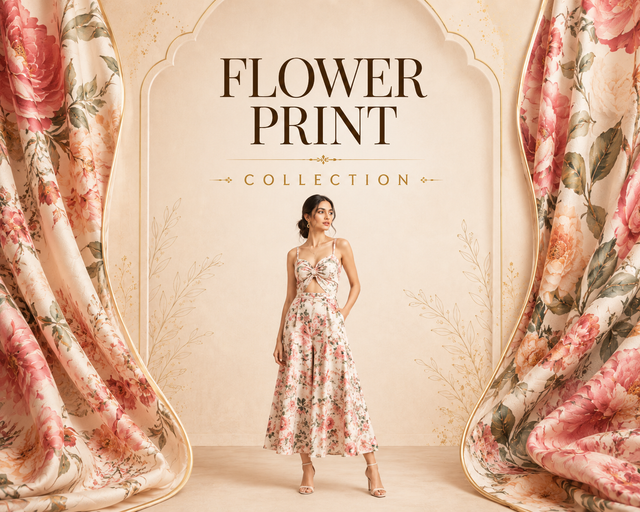 A closer look at print.
Explore colour, pattern and fabric together.
Explore floral prints
A closer look at print.
Explore colour, pattern and fabric together.
Explore floral prints
Shop by pattern
Explore fabrics
Real photographs of each base. Hover a picture to look closer at the weave.
 fabric texture
ChiffonSheer, light, airy fall63 fabrics →
fabric texture
ChiffonSheer, light, airy fall63 fabrics →
 fabric texture
GeorgetteLight, grainy, flowing33 fabrics →
fabric texture
GeorgetteLight, grainy, flowing33 fabrics →
 fabric texture
CrepeMatte pebbled surface, easy drape1490 fabrics →
fabric texture
CrepeMatte pebbled surface, easy drape1490 fabrics →
 fabric texture
Moss crepeSoft moss-grain texture201 fabrics →
fabric texture
Moss crepeSoft moss-grain texture201 fabrics →
 fabric texture
SatinSmooth with a glossy sheen253 fabrics →
fabric texture
SatinSmooth with a glossy sheen253 fabrics →
 fabric texture
Armani satinFluid satin with 5% Lycra127 fabrics →
fabric texture
Armani satinFluid satin with 5% Lycra127 fabrics →
 fabric texture
Lycra & stretchStretches and recovers331 fabrics →
fabric texture
Lycra & stretchStretches and recovers331 fabrics →
 fabric texture
SpandexFour-way stretch knit201 fabrics →
fabric texture
SpandexFour-way stretch knit201 fabrics →
 fabric texture
TexturedRaised surface you can feel186 fabrics →
fabric texture
TexturedRaised surface you can feel186 fabrics →
 fabric texture
NetOpen mesh, holds shape7 fabrics →
fabric texture
NetOpen mesh, holds shape7 fabrics →
 fabric texture
LurexMetallic-thread sparkle28 fabrics →
fabric texture
LurexMetallic-thread sparkle28 fabrics →
 fabric texture
Cotton & blendsBreathable, crisp hand1844 fabrics →
fabric texture
Cotton & blendsBreathable, crisp hand1844 fabrics →
 fabric texture
Solid coloursPlain-dyed in every shade345 fabrics →
fabric texture
Solid coloursPlain-dyed in every shade345 fabrics →
Understanding different fabric types is essential for anyone involved in fashion, textile business, or home crafting. This beginner's guide explains the main fabric categories, their characteristics, and best uses in garment making and home furnishings.

Natural fibers are obtained from plants and animals. Cotton is the most popular natural fiber, known for breathability and comfort. Silk offers luxurious feel and excellent draping. Linen provides durability and coolness. Wool offers warmth and insulation. These fabrics are biodegradable and eco-friendly.
Polyester is the most widely used synthetic fiber, offering durability and easy care. Nylon provides strength and elasticity. Acrylic offers warmth similar to wool. Synthetic fabrics are affordable, long-lasting, and require minimal maintenance.
Rayon and viscose are made from cellulose derived from wood pulp. These fabrics offer the feel and drape of silk at lower cost. They are breathable and comfortable to wear. Modal and tencel are improved versions offering better durability.
Lightweight fabrics like chiffon and georgette are perfect for elegant, flowing garments. Organza offers structure with sheerness. These fabrics are ideal for sarees, dupattas, and special occasion wear.
Crepe fabrics have texture and drape well. Poplin offers crisp structure. Cotton twill provides durability. These fabrics are suitable for shirts, trousers, and everyday wear.
Heavy fabrics like velvet and canvas provide structure and durability. Denim is perfect for casual wear and workwear. Heavy silk is ideal for formal wear. These fabrics require careful handling in garment making.
Blended fabrics combine natural and synthetic fibers to optimize properties. Cotton-polyester blends offer comfort and durability. Silk-polyester blends provide the look of silk with better maintenance. Printed fabrics add visual interest and design elements.
Weight refers to fabric thickness measured in GSM (grams per square meter). Weave structure affects durability and appearance. Stretch and recovery determine fabric flexibility. Breathability affects comfort in hot climates. Luster and sheen influence the fabric's visual appeal.
Consider the garment type and intended use when selecting fabric. Check fabric weight and drape properties. Verify care requirements and maintenance needs. Ensure the fabric suits your climate and season. Order samples to test quality before bulk purchase.
Calculate fabric quantity accurately for your project. Buy slightly extra for shrinkage and errors. Check fabric grain and direction of nap. Verify dye lot numbers for consistent color. Purchase from reliable suppliers like Clothwala for quality assurance.
Our merchandising team replies within 2 working hours. Optional, but helps us prioritize.
Verify your number to unlock your code
Enter the OTP sent to your WhatsApp
Use this code for 5% off your first order