

Blog posts
-
, by Author Article title
-
, by Author Article title
-
, by Author Article title
Free shipping above ₹1,199 · Sample from 1 metre · GST invoice on every order
Shop by fabric
Chiffon63Georgette33Crepe1490Moss Crepe201Satin253Armani Satin127Lycra & Stretch331Spandex201Solid Colours345Shop by blend
View all fabricsShop by pattern
Floral prints1319Abstract prints939Animal prints551Geometric prints630Polka Dot prints178Stripes prints196Tropical prints358Ethnic & Placement prints1035Baroque prints82Paisley prints36Graphic prints563Explore
All printed fabrics New arrivals Print your own design Custom colour dyeing Fabric sample books Bulk & custom orders International orders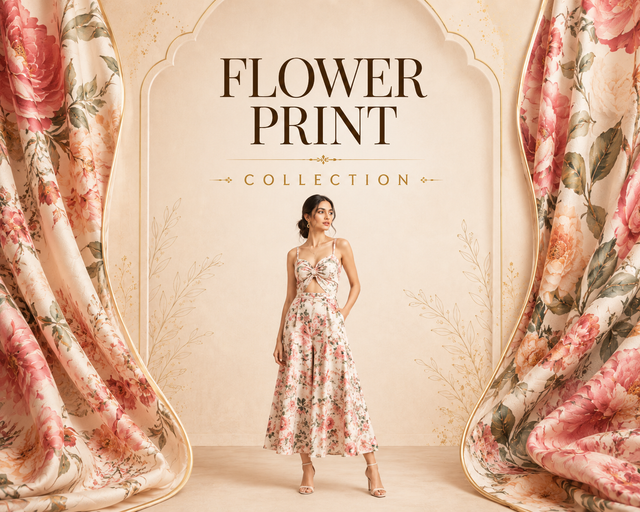 A closer look at print.
Explore colour, pattern and fabric together.
Explore floral prints
A closer look at print.
Explore colour, pattern and fabric together.
Explore floral prints
Shop by pattern
Explore fabrics
Real photographs of each base. Hover a picture to look closer at the weave.
 fabric texture
ChiffonSheer, light, airy fall63 fabrics →
fabric texture
ChiffonSheer, light, airy fall63 fabrics →
 fabric texture
GeorgetteLight, grainy, flowing33 fabrics →
fabric texture
GeorgetteLight, grainy, flowing33 fabrics →
 fabric texture
CrepeMatte pebbled surface, easy drape1490 fabrics →
fabric texture
CrepeMatte pebbled surface, easy drape1490 fabrics →
 fabric texture
Moss crepeSoft moss-grain texture201 fabrics →
fabric texture
Moss crepeSoft moss-grain texture201 fabrics →
 fabric texture
SatinSmooth with a glossy sheen253 fabrics →
fabric texture
SatinSmooth with a glossy sheen253 fabrics →
 fabric texture
Armani satinFluid satin with 5% Lycra127 fabrics →
fabric texture
Armani satinFluid satin with 5% Lycra127 fabrics →
 fabric texture
Lycra & stretchStretches and recovers331 fabrics →
fabric texture
Lycra & stretchStretches and recovers331 fabrics →
 fabric texture
SpandexFour-way stretch knit201 fabrics →
fabric texture
SpandexFour-way stretch knit201 fabrics →
 fabric texture
TexturedRaised surface you can feel186 fabrics →
fabric texture
TexturedRaised surface you can feel186 fabrics →
 fabric texture
NetOpen mesh, holds shape7 fabrics →
fabric texture
NetOpen mesh, holds shape7 fabrics →
 fabric texture
LurexMetallic-thread sparkle28 fabrics →
fabric texture
LurexMetallic-thread sparkle28 fabrics →
 fabric texture
Cotton & blendsBreathable, crisp hand1844 fabrics →
fabric texture
Cotton & blendsBreathable, crisp hand1844 fabrics →
 fabric texture
Solid coloursPlain-dyed in every shade345 fabrics →
fabric texture
Solid coloursPlain-dyed in every shade345 fabrics →
Ask any fashion brand owner about their biggest supply chain regret, and the answer is almost always the same: "We overbought fabric last season." Dead stock is the silent profit killer of the fashion industry. It ties up working capital, occupies warehouse space, and ages out of relevance faster than almost any other product category.
Spring Summer 2026 presents both an opportunity and a risk. The season's trend signals are clear and commercially strong, which means brands that buy the right fabrics will profit handsomely. But the same clarity that makes SS26 appealing also makes it easy to overbuy, chasing every trend color and fabric type without a disciplined framework.
This guide gives fashion brands a structured approach to sourcing SS26 fabrics, one that ensures trend alignment without inventory overcommitment.

Overbuying is rarely the result of poor intentions. It happens because of a combination of structural pressures that are difficult to resist:
For the SS26 season specifically, the risk of overbuying is compounded by a wide trend palette and multiple viable fabric directions. Brands that do not have a buying framework in place risk spreading spend across too many categories, ending up with too little of what sells and too much of what does not.
The first step in smart fabric sourcing is not visiting a supplier. It is deciding which SS26 trends are actually relevant to your brand's customer and sales channel. Not every SS26 trend belongs in your collection.
For example: Electric Fuchsia is a strong SS26 color. But if your brand sells largely to corporate gift buyers or neutral-loving minimalists, fuchsia may not belong in your core range. It might belong in a limited-edition capsule, or not at all.
Tool Tip: Build a simple 3-column sheet: Trend, Customer Relevance Score (1 to 10), Budget Allocation (%). Cap any single trend at 15 to 20% of your total fabric budget unless it is a proven winner for your brand.
One of the most effective frameworks for avoiding overbuying is the Core vs. Capsule model. It creates a natural spending discipline that matches your buying volume to your certainty level.
These are fabrics you are highly confident in: proven performers for your brand, trend-adjacent rather than trend-dependent, and versatile across multiple silhouettes. For SS26, these typically include:
These are trend-forward, higher-risk purchases. The fabrics that will define your most photographed pieces and carry your brand's SS26 story, but which you buy in tighter quantities. For SS26:
This split ensures you have enough volume to sustain production without being exposed to deep inventory if a capsule trend underperforms.
Before committing to a full fabric order, sample every trend fabric you are unsure about. This sounds obvious, but the majority of overbuying happens precisely because brands skip or rush the sampling step under production pressure.
Clothola Advantage: Clothola's Fabric Sample Book collection lets you order curated fabric samples across categories before committing to bulk quantities. Fast dispatch, low minimum quantities for sampling, so you can validate before you buy.
Most fabric suppliers have standard MOQ requirements, but many are more flexible than brands assume, especially when you are buying from a portal that aggregates orders. Here are three proven strategies to manage MOQ pressure without overbuying:
Instead of buying 10 different fabric types in small quantities, buy 4 to 5 types in slightly larger quantities. This typically brings MOQ requirements within reach while keeping total fabric expenditure controlled.
Co-operative fabric buying, where two non-competing brands split a fabric order, is increasingly common among small and mid-sized fashion brands. It allows both brands to access trend fabrics that would otherwise be out of reach on individual MOQ terms.
Rather than placing your entire SS26 fabric order upfront, negotiate with your supplier to place a base order now (70%) and a top-up order mid-season (30%) once early sell-through data is available. Many fabric portals, including Clothola, support this kind of phased ordering.
One of the most common causes of overbuying is buying fabric at a pace that exceeds your production capacity. If your unit can produce 500 pieces per month and you buy fabric for 2,000, you will inevitably sit on excess.
Simple Capacity Check Formula:
Maximum Fabric Buy (metres) = Monthly Production Capacity (pieces) x Average Fabric per Piece (metres) x Number of Months in Selling Window
Example: 500 pieces per month x 2.5 metres per piece x 3 months = 3,750 metres maximum buy for a core fabric.
Run this calculation for each fabric in your SS26 plan. It will quickly reveal which fabric orders are genuinely aligned with production reality and which are aspirational buys that will end up as dead stock.
Smart buyers plan for excess before they purchase. Before finalising any SS26 fabric order, have an answer to this question: "If 20% of this fabric is unsold at the end of season, what will I do with it?"
Brands with a clear excess-fabric strategy are far more comfortable buying at the right volume because they have a backstop plan. Brands without one tend to either overbuy carelessly or under-buy out of fear, both of which hurt the business.
Fashion brands that follow this framework will enter SS26 with the right fabrics, the right quantities, and the right inventory position, without the dead stock hangover that costs so many brands so dearly each season.
The most effective approach is to separate your buying into Core fabrics (proven, versatile, high confidence) and Capsule fabrics (trend-driven, limited quantities). Always sample before committing to bulk orders, and calculate your buy volume against actual production capacity rather than aspirational targets.
Use a simple capacity formula: Monthly production capacity (pieces) x Average fabric per piece (metres) x Number of months in selling window. This gives you a ceiling for each fabric SKU. Never buy above this ceiling without a clear sell-through rationale.
MOQ varies by fabric type and supplier, typically 50 to 100 metres for plain fabrics and 25 to 50 metres for digital prints or speciality fabrics. Portals like Clothola often offer lower entry MOQs for sampling, allowing brands to validate before committing to full-quantity orders.
Yes, and you should. Clothola's Fabric Sample Book collection allows brands to order small quantities of curated fabrics before committing to bulk. This is the most effective way to validate colour, texture, and drape before production begins.
Options include: selling excess fabric at a discount through B2B channels, carrying versatile fabrics into the next season, using excess for accessories or packaging, or listing surplus on wholesale platforms. The key is to plan your excess-fabric strategy before buying, not after.
Our merchandising team replies within 2 working hours. Optional, but helps us prioritize.

Verify your number to unlock your code
Enter the OTP sent to your WhatsApp
Use this code for 5% off your first order